
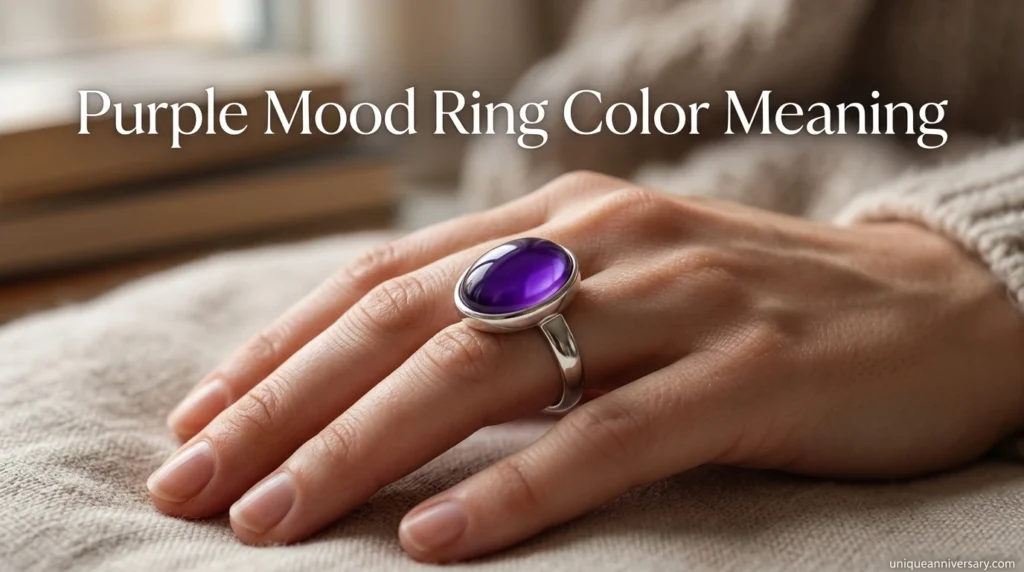
Imagine sitting in a quiet room, turning a small ring on your finger, and watching it slowly shift from a neutral tone into a rich shade of purple. It feels almost magical—like the ring is reading your thoughts, decoding your emotions, and reflecting something you may not even have put into words yet. Mood rings have fascinated people for decades, not just as playful accessories but as symbolic tools that seem to mirror inner emotional states. Among all the colors they display, purple stands out as one of the most intriguing and misunderstood.
The purple mood ring color meaning is often associated with deeper emotional layers, intuition, creativity, and even romantic or spiritual awareness. But its interpretation isn’t always straightforward. Depending on the context, purple can signal calm confidence, emotional depth, or a heightened sense of imagination. In real life, understanding what purple represents can help people become more aware of their moods, reactions, and emotional patterns. This article explores the many dimensions of purple in mood rings, helping you see beyond the surface into what this captivating color may truly reflect about your inner world.
The Science and Symbolism Behind Mood Rings
Mood rings were invented in the 1970s and quickly became a cultural sensation. At their core, they rely on thermochromic liquid crystals that change color based on temperature. Your skin temperature shifts slightly depending on your emotional and physical state, which is why the ring appears to “respond” to your mood.
Purple often appears when the body is in a balanced or slightly elevated emotional state. This doesn’t mean the ring is reading your thoughts—it’s responding to physiological changes like blood flow and heat levels. However, people naturally connect these shifts to emotional symbolism.
Symbolically, purple has long been linked to mystery, wisdom, and spirituality. Ancient cultures associated purple with royalty and higher consciousness because the dye was rare and valuable. When this historical symbolism merges with the modern mood ring concept, purple becomes more than a color—it becomes a reflection of inner depth and emotional richness.
This blend of science and symbolism is what makes mood rings so fascinating. They sit at the intersection of biology and imagination, where physical reactions meet personal interpretation.
General Purple Mood Ring Color Meaning
The purple mood ring color meaning is commonly associated with calm awareness, emotional balance, and subtle excitement. It is not an extreme emotional state like anger or stress, but rather a middle ground where thoughts and feelings are active yet controlled.
When your ring turns purple, it may suggest that your body is warm and stable, often linked to feelings of comfort or engagement. Emotionally, this can be interpreted as being “in tune” with yourself or your surroundings.
Purple is also seen as a transitional color—something between grounded stability (like blue) and passionate energy (like red). This makes it a symbol of emotional complexity. You might not be overly excited or deeply relaxed, but somewhere in a thoughtful, reflective space.
People often report seeing purple during moments of conversation, creativity, or mild emotional stimulation. It is a color that suggests presence—being mentally and emotionally “awake” without being overwhelmed.
Emotional Depth and Inner Awareness
Purple is deeply connected to emotional awareness. When your mood ring displays purple, it can reflect a heightened sensitivity to your environment or thoughts. You may be processing emotions more deeply than usual, even if you don’t consciously realize it.
Subtle Emotional Processing
Sometimes purple appears when you are quietly reflecting on something meaningful—like a memory, conversation, or personal decision. It doesn’t indicate emotional chaos; instead, it suggests internal processing.
Awareness Without Overwhelm
Unlike intense colors that signal stress or excitement, purple represents controlled emotional engagement. You are aware, thoughtful, and mentally active, but still grounded.
This makes purple a fascinating emotional mirror. It reminds us that not all emotional activity is loud or dramatic—some of it happens quietly beneath the surface, shaping our thoughts and decisions in subtle ways.
Romantic Interpretations of Purple Mood Rings
In romantic contexts, the purple mood ring color meaning often takes on a softer, more intimate tone. It can suggest attraction, emotional curiosity, or a growing sense of connection.
When two people are talking and one notices their ring turning purple, it may reflect emotional engagement with the interaction. This doesn’t automatically mean love, but it can indicate interest and emotional openness.
Early-Stage Feelings
Purple is often linked to the early stages of emotional bonding—when curiosity and attraction begin to form but are not yet fully defined.
Emotional Connection
It can also reflect a sense of emotional resonance with someone else, where conversations feel meaningful and mentally stimulating.
In relationships, purple can symbolize the “thinking heart”—where emotions and intellect blend, creating a deeper kind of awareness between individuals.
Intuition, Spiritual Awareness, and Inner Guidance
One of the most widely accepted symbolic meanings of purple is intuition and spiritual awareness. In mood ring interpretations, purple is often seen as a sign of heightened inner perception.
When your ring turns purple, it may represent a moment where you are more in tune with your instincts. You might be sensing something about a situation without having clear logical proof.
Subtle Inner Signals
These moments can feel like quiet understanding—when something “just feels right” or “doesn’t feel right” without explanation.
Reflective States
Purple can also appear during meditation, introspection, or calm thinking. It represents a mental space where external noise fades, allowing inner thoughts to surface more clearly.
This makes purple a powerful symbol of inner alignment, where emotions and intuition work together.
Creativity and Imagination in Purple Energy
Purple is strongly associated with creativity, imagination, and artistic thinking. When it appears on a mood ring, it may suggest that your mind is actively generating ideas or exploring possibilities.
People often notice purple during brainstorming, daydreaming, or engaging in creative activities like writing, drawing, or music.
Flow of Ideas
In this state, thoughts come more freely and without strict structure. It is a mental environment where imagination feels natural and unrestricted.
Inspired Thinking
Purple can also reflect inspiration—those sudden moments when ideas feel vivid or meaningful.
This creative association makes purple one of the most dynamic mood ring colors, representing mental expansion rather than emotional extremes.
Confusion, Mixed Emotions, and Subtle Conflict
Although purple is often seen positively, it can also indicate mild emotional confusion or mixed feelings. This doesn’t mean distress, but rather a state of uncertainty.
Overlapping Thoughts
You might be thinking about multiple things at once, such as decisions, relationships, or personal goals.
Emotional Ambiguity
In some cases, purple reflects a blend of emotions that are not fully resolved—such as excitement mixed with hesitation.
Instead of signaling negativity, this version of purple represents a thinking phase where clarity has not yet formed. It’s a reminder that emotional understanding often develops gradually.
Real-Life Situations Where Purple Appears
Purple mood ring readings often show up in everyday life during moments of mental engagement or emotional reflection.
For example:
- During meaningful conversations with friends
- While making decisions or solving problems
- When listening to music that triggers emotions
- In calm but mentally active environments
In these situations, your body temperature remains stable, but your mind is active. This balance often produces purple tones in mood rings.
Purple in daily life reflects engagement—not passivity or extreme emotion. It represents being mentally present and emotionally responsive to your surroundings.
Purple in Relationships and Social Interactions
In relationships, purple often signals emotional connection mixed with thoughtful awareness. It can appear when you are deeply listening to someone or emotionally processing shared experiences.
Understanding Others
Purple may indicate empathy and attentiveness, where you are not just hearing words but interpreting emotional meaning.
Emotional Balance in Interaction
It also suggests a balanced emotional state during social engagement—neither overly excited nor detached.
In friendships or romantic interactions, purple can symbolize meaningful connection where communication feels intellectually and emotionally rich.
Psychological Perspective of Purple Mood Rings
From a psychological standpoint, the purple mood ring color meaning can be seen as a reflection of cognitive and emotional integration.
When people experience mild emotional arousal combined with mental focus, their body responds in subtle physiological ways. This may include slight temperature changes that influence mood ring color.
Purple, in this sense, represents a middle state between emotional intensity and calm reasoning. Psychologically, it aligns with reflective thinking, problem-solving, and emotional processing.
It highlights how human emotions are not binary but layered and dynamic. Purple becomes a symbol of mental balance, where thought and feeling coexist.
Common Myths and Misunderstandings About Purple
Many people assume mood rings accurately “read emotions,” but this is a misconception. The color changes are based on temperature, not direct emotional detection.
Myth 1: Purple Means You Are in Love
While purple can appear during romantic interest, it does not specifically indicate love.
Myth 2: Purple Has One Fixed Meaning
In reality, purple can represent multiple emotional and mental states depending on context.
Myth 3: Mood Rings Are Emotion Readers
They respond to physical changes, not psychological data.
Understanding these myths helps create a more realistic and meaningful interpretation of purple mood ring readings.
Practical Lessons From Purple Mood Ring Meaning
The purple mood ring color meaning offers more than symbolic interpretation—it can encourage self-awareness.
When you notice purple, you can use it as a reminder to reflect:
- What am I thinking about right now?
- Am I emotionally engaged or simply processing information?
- Is there something I need to understand more deeply?
Purple encourages mindfulness. It invites you to slow down and observe your emotional state without judgment.
It also highlights the importance of balance—between logic and emotion, action and reflection. In this way, a simple color becomes a tool for personal insight.
Conclusion
Purple on a mood ring is more than a shifting shade—it is a reflection of complexity within the human experience. It represents emotional awareness, creativity, intuition, and thoughtful engagement with life. Unlike extreme colors that signal strong emotions, purple sits in a balanced space where thinking and feeling merge.
Understanding the purple mood ring color meaning helps us appreciate the subtle ways our bodies and minds respond to the world. It reminds us that emotions are not always loud or obvious; sometimes they appear quietly, like a soft shade of purple on a ring. In those moments, we are not overwhelmed or detached—we are simply present, aware, and deeply human.
FAQs
What does purple mean on a mood ring?
Purple generally represents emotional balance, intuition, creativity, and mental engagement. It suggests a calm but active emotional state.
Does purple on a mood ring mean love?
Not directly. While it can appear during romantic interest, it more commonly reflects emotional awareness or curiosity.
Why does my mood ring turn purple often?
It may be due to stable body temperature combined with active thinking or mild emotional stimulation.
Is purple a good or bad mood ring color?
Purple is considered a positive and balanced color, often linked to creativity, reflection, and emotional awareness.
Can mood rings really read emotions?
No, mood rings respond to temperature changes in your skin, not direct emotional readings.
What emotions are linked to purple in color psychology?
Purple is associated with imagination, wisdom, introspection, and spiritual or intuitive thinking.